Mixing Memory and Desire: The Postmodern and The Construction of Authority
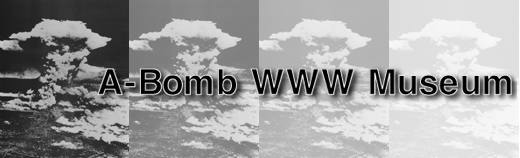
A Reading of the A-Bomb WWW Museum--http://www.csi.ad.jp/ABOMB/
by John DiMoia
Introduction
Paul Fussell's "Thank God for the Atom Bomb" (1988), an essay which first appeared in The Atlantic Monthly, created a furor upon its publication, its very title inviting controversy. Recalling his experiences as a GI during the Second World War, Fussell hoped to convey the immense sense of relief he experienced when he learned of the war's end over the radio. More importantly, he wanted to remind Americans of the 1980's--educated to condemn the use of atomic weapons--that news of the bomb was originally greeted with enthusiasm, emphasizing the fact that no situation is clearcut when it involves human lives. For Fussell, the decision to employ the bomb was part of a necessary but complicated process, one which involved a great deal of reflection on the part of the American military leadership. With the fiftieth annivesary of the event approaching (August 1995), he wanted to stimulate debate, raising complex issues about moral authority in relation to the historical past.
Along with the Holocaust, the dropping of the atomic bomb on Hiroshima has often been cited as the defining moment of postmodernism, effectively putting an end to the Enlightenment dream of progress based on reason. The effect of the bomb, encompassing its physical impact as well as its psychological aftershock, created a situation for which there was literally no language, an event which exceeded the boundaries of representation. Indeed, the nature of the event was such that its subsequent depiction has become a contested site, the subject of controversy. For example, accounts provided by survivors (e.g., John Hersey's Hiroshima, or Kenzaburo Oe's Hiroshima Notes), while emotionally moving, might be faulted for their tendency to represent only one side of the experience, capturing the horror while ignoring the larger historical context. Similarly, the decision to exhibit the Enola Gay at the Smithsonian Institute illustrated the difficulty of establishing a "historical" (an objective, master narrative) point of view in the absence of the human element.
The site I have chosen addresses these and similar issues. In particular, it asks questions such as:
-Who "owns" a historical event? What use should be made of such an event?
-How can the horrific (a tragedy, a devastating event) be represented? What kind of authority is appropriate in rendering such an event?