Urban Reform
In Silver Cities: The Photography of American Urbanization, 1839-1915
(1984), Peter Hales credits Riis with the formation of a reform-oriented
rhetoric which would influence documentary work well into the next century.
Even as he praises Riis's intent, however, Hales acknowledges the journalist's
agenda: "what Riis wanted, and what he found in his photography, was
a means of hiding his hand, erasing his presence as
authority and transferring that authority to an apparently irrefutable
medium of proof" (193). In particular, Hales points to many of Riis's
preferred framing devices--e.g., disorder, clutter, crowded interior space--as
an indication of his ability to create (or enhance) a sense of "claustrophobic
enclosedness" (201), drawing the viewer into sympathetic identification.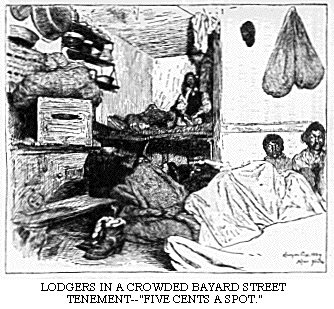 Further, he adds, the camera often focuses on corners and ceilings, contributing
to the impression of enclosure. As with Brady's photographs, Riis works
as a dramatist, highlighting conflict (e.g., light/dark, open/closed) to
convey a message quickly and persuasively.
Further, he adds, the camera often focuses on corners and ceilings, contributing
to the impression of enclosure. As with Brady's photographs, Riis works
as a dramatist, highlighting conflict (e.g., light/dark, open/closed) to
convey a message quickly and persuasively.