The Civil War, Continued
The legacy of the images gathered by Brady and others is primarily one
of retrospection, capturing the aftermath of a battle--bodies splayed in
disarray--for example, in terms of its destructive force. Instances of
"live" action are rare, if they exist at all, and Davis (1991)
maintains that "no clear image of a battle has been identified"
(134). In terms of a governing point of view, then, the outlook is one
dominated by loss, a position (possibly) reinforced by the fact that the
majority of those taking pictures were working on behalf of the Union.
In addition, the relationship between the medium and the market determined
what subjects would be captured on film (e.g., shots
of important leaders, encampments, bodies awaiting burial), preserved
with future sales in mind.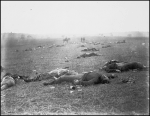 Even with a range of subject matter, the images tend to highlight contrast
and conflict (e.g., the binary of North and South), portraying the content
as a narrative of division. An invaluable contribution to collective memory,
the Brady collection also emphasizes the limitations of the photographic
record, the necessity of looking beyond isolated images.
Even with a range of subject matter, the images tend to highlight contrast
and conflict (e.g., the binary of North and South), portraying the content
as a narrative of division. An invaluable contribution to collective memory,
the Brady collection also emphasizes the limitations of the photographic
record, the necessity of looking beyond isolated images.