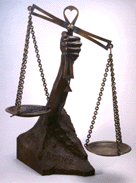
 Lanham's
comment about judicial precedent is not quite correct. The jury's
role is that of fact-finder. The jury never makes laws or precedent.
Contrary to Lanham's suggestion, the jury's decision about what the
facts are in a particular case -- what "version of reality" it
accepts -- applies only to the case before it, and has no precedential
value whatsoever. Determinations of what law applies, and the proper
method of application are made by judges (at trial or on appeal) with reference
to a pre-existing canon-- i.e. case-law, statutes etc. Only judicial determinations,
regarding the law, and its application to the facts, as found by the jury
(or judge), can serve as precedent.
Lanham's
comment about judicial precedent is not quite correct. The jury's
role is that of fact-finder. The jury never makes laws or precedent.
Contrary to Lanham's suggestion, the jury's decision about what the
facts are in a particular case -- what "version of reality" it
accepts -- applies only to the case before it, and has no precedential
value whatsoever. Determinations of what law applies, and the proper
method of application are made by judges (at trial or on appeal) with reference
to a pre-existing canon-- i.e. case-law, statutes etc. Only judicial determinations,
regarding the law, and its application to the facts, as found by the jury
(or judge), can serve as precedent.
This distinction is important in the evaluation of Lanham's
Strong Defense of rhetoric. The jury is required, based on
the pre-existing canon, a fixed philosophy for purposes of the jury's
decision, to make a judgement in the case before it. When
Lanham argues that "that decision is made by people, not handed down
by God," he seems to assume that a decision by people somehow
must exclude a decision by God. But if you trace any decision "made
by people" back to its original source, sooner or later you come
to a fiat, the equivalent of transcendent moral authority. There
may be other contradicting fiats. But, of course, that does not mean
that truth is ultimately indeterminate or relative (as Lanham concedes).
It is only half true to say that we use a "system by which we can agree on a series of contingent operating premises" in order to make judgements. For the "system" spoken of by Lanham was not merely "agreed upon" in a vacuum. In fact, it is philosophy, that dictates what system will allow fair judgments to be made. (The Due Process of Law provisions in the Bill of Rights are a notable example of how rhetoric, or procedure, is dictated by underlying philosophy.)